

More Choice, More Consequence: Seattle’s Market Reset Rewards Precision
Seattle’s housing market has shifted further toward buyers as the third quarter begins, but this is better understood as a market reset than a correction. Inventory has climbed to new highs for the period, sales have slowed materially; condos have moved into clear buyers’ market territory, townhomes are more balanced while single-family homes remain comparatively resilient.
Economic backdrop
The broader economy is still setting the tone for housing. In Seattle, affordability is being shaped not just by home prices but by the combination of mortgage rates, persistent inflation pressuring household budgets, and a labor market that feels less secure than it did when tech hiring was driving much of the region’s momentum. Affordability has improved modestly, not dramatically.
Seattle’s July median residential price was $999,500—1% below a year earlier—and the average 30-year fixed rate eased into 6.54%, compared with 6.72% last July, offering modest payment relief. Together, those changes reduced estimated principal-and-interest payments by approximately $187 per month. The improvement gives qualified buyers more breathing room, but payment sensitivity remains the central constraint on demand.
Inflation is also still part of the story. The June 2026 CPI release notes that consumer prices in the Seattle metro rose about 4.5% over the 12 months from June 2025 to June 2026, one of the highest inflation readings among major metros. That means even households with stable incomes are feeling the drag of higher everyday costs, making buyers more payment-sensitive and more selective.
The labor market adds another layer of caution. King County unemployment peaked at 5.7% in January 2026 and eased to 4.9% by June. Note this does not include recent layoffs from Microsoft, Amazon, Meta, Zillow, Salesforce, and Starbucks. Hiring has shifted away from tech and toward sectors like healthcare and services, while layoffs have remained concentrated in the information sector. For housing, that means less urgency, more analysis, and a market where confidence matters just as much as affordability.
Market Performance – King County
The defining story entering Q3 is expanding choice. In July 2026, King County recorded 4,192 new listings, up 15% from a year earlier, while active inventory reached 7,926 listings, up 23% year over year and the highest level in available data dating back to 2013.
At the same time, buyer activity in King County has softened. Closed sales fell to 2,117 in July, down 14% from July 2025 and 31% below the prior 10-year July average, making this the weakest July for sales in the available dataset. That combination of more supply and fewer transactions is changing the feel of the market from urgency-driven to comparison-driven, with buyers spending more time evaluating condition, value, and concessions before acting.
What the July data says for Seattle
Seattle has moved from a uniformly competitive market to a two-speed market. Residential supply reached 2.9 months in July, creating more room for due diligence and negotiation on homes that miss the market. But properly priced, well-prepared listings can still draw immediate competition: 64% of July residential sales closed within 15 days and at 100% of original asking price, while 31% sold above asking price.
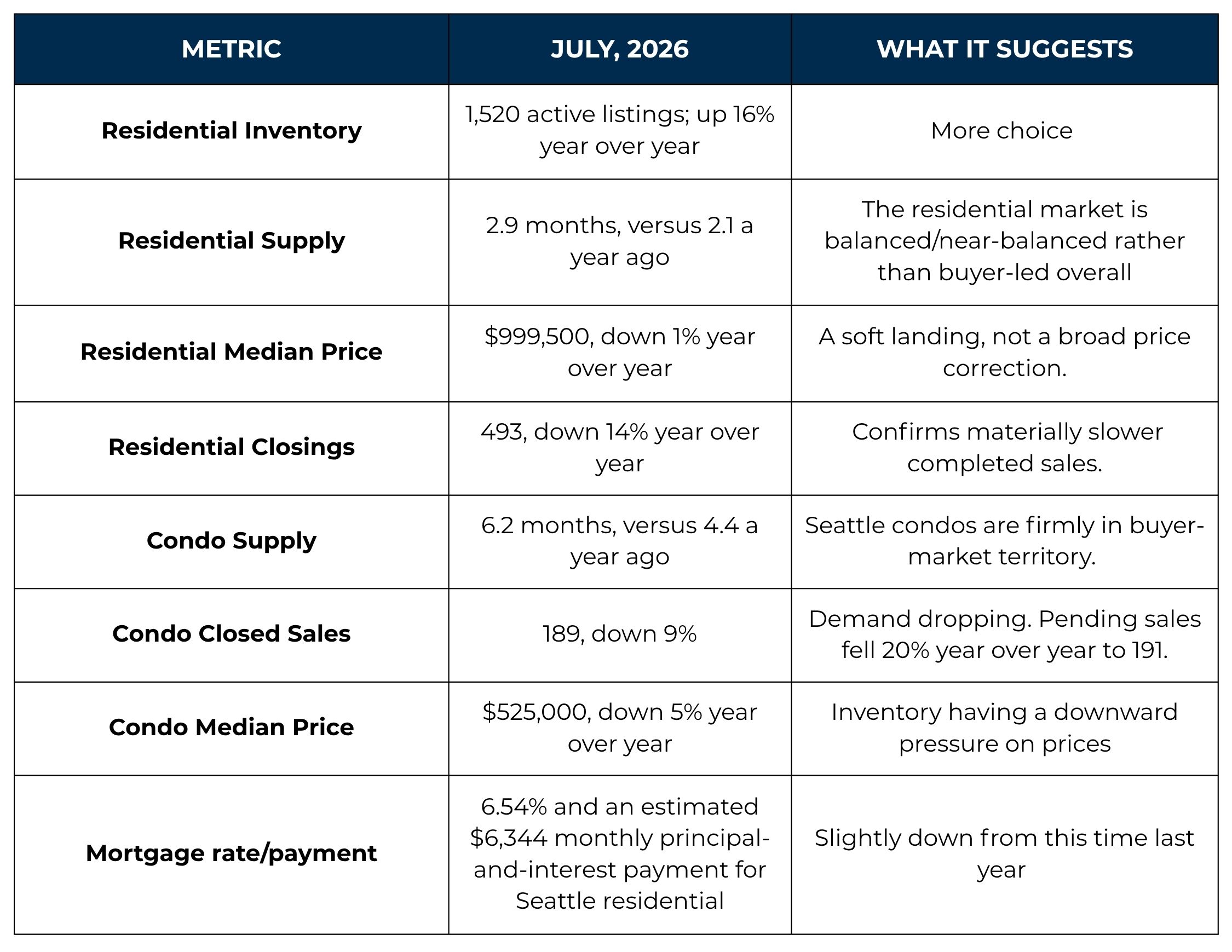
This is an important distinction for clients: price resistance is showing up more through longer decision cycles, selective demand, and increased negotiating room than through dramatic price declines.
Segment differences in Seattle
The headline market story changes meaningfully by product type. Single-family homes remain the strongest segment, townhomes are closer to balanced, and condos now offer buyers the most leverage.
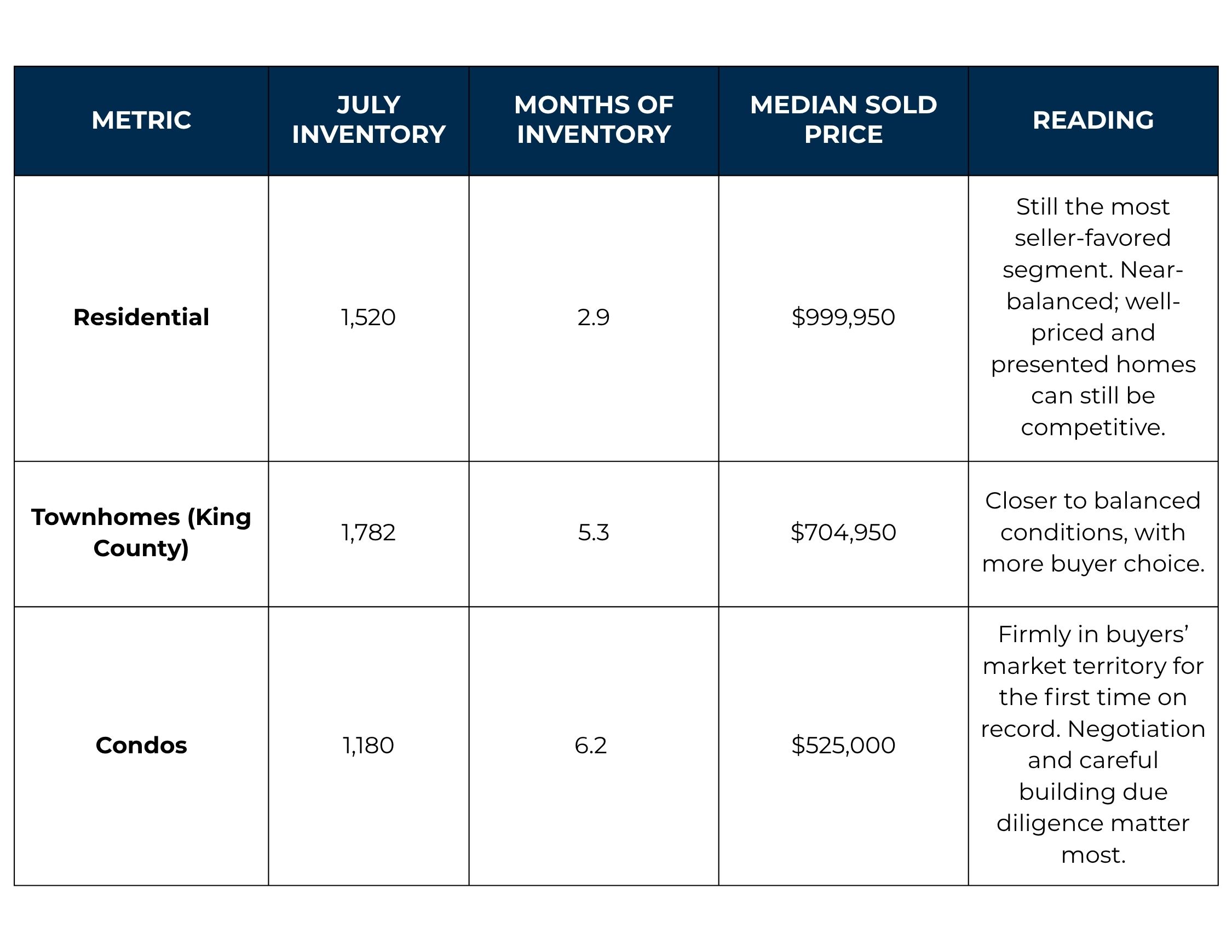
Condominiums offer buyers the clearest opportunity. Investor interest is beginning to return, suggesting that buying may now be less expensive than building, renting may cost as much as—or more than—owning, and the market may be nearing its bottom. Seattle condo supply reached 6.2 months in July, while active listings rose 12% and pending sales fell 20% from a year earlier. The median condo price declined 5% to $525,000 (Seattle vs. King County). Buyers should use the expanded selection to evaluate HOA financials, reserve funding, assessments, rental restrictions, insurance, and total ownership costs—not just negotiate price. Also, negotiations should consider back- end concessions like closing costs and interest rate buydowns.
A note about luxury homes[1]: First off, the market for luxury versus starter homes has split. The top 5% of houses by home value are selling fast, face shrinking supply shortages, and often draw bidding wars. Meanwhile, moderate home listings grew 4.5% YoY, yet are selling at a much slower pace.
[1] Defined as homes over $1,900,000
What it means for buyers and sellers
For buyers, this is one of the more favorable Seattle-area setups seen in several years. More listings, slower absorption, and higher inventory create more room to compare homes carefully, preserve contingencies, and negotiate terms that would have been difficult to secure in a tighter market.
Buyers should distinguish between a new, correctly priced listing and a stale listing. The July data supports this: well-priced new listings may still trade in 5–8 days and above asking, whereas homes that have sat more than 30 days generally offer more room for price or term negotiations.
Suggested buyer action items:
- Be fully underwritten and ready to compete for a strong new listing, especially in high-demand residential submarkets.
- Preserve inspection, financing, or appraisal protections where property history and leverage support them.
- Pursue price reductions, seller-paid closing costs, repair credits, rate buydowns, and timing flexibility on longer-market listings.
- For condos, perform deeper HOA and special-assessment due diligence before treating a lower price as a value.
For sellers, the penalty for missing the launch price has widened. July data shows that homes selling in the first 15 days achieved 100% of original list price at the median. By contrast, homes taking 61–90 days sold at a median 92% of original list price. In a market with more alternatives, the first two weeks are increasingly decisive. For condo sellers, the July data indicates only 9% sold above list, 41% sold below list, and 27% had a price change before sale.
Three practical seller priorities stand out in this environment:
- Prepare thoroughly before launch, including repairs, pre-listing inspection strategy, and cosmetic improvements where needed.
- Price for the market that exists now, not the market sellers remember from peak scarcity.
- Present the home with strong staging, photography, and marketing because buyers have more side-by-side alternatives.
- For condo sellers, the operational takeaway is clear: price discipline, building-level differentiation, and transparent HOA documentation are no longer optional.
Winning the offer is not the same as closing the sale. With fall-through risk elevated, sellers should assess buyer financing strength, appraisal exposure, contingency structure, earnest money, and timeline reliability—not solely the highest price. Maintain backup interest until contingencies are satisfied.
Looking Forward: Neighborhood and Property-type Strategy Wins the Day
Data provides direction, but neighborhood and property-type context matters more than ever. The best outcomes this quarter will come from matching strategy to product type, neighborhood, and timing rather than relying on a single headline about the broader Seattle market.
The most effective Q3 strategies will be highly specific: buyers should target segments where inventory has expanded fastest, and sellers should position homes against immediate neighborhood competition rather than broad metro headlines.
If you are considering a move, or simply want a grounded read on your neighborhood, reach out for a custom market snapshot, pricing strategy session, or buyer game plan tailored to your goals.

The Current Moment: Uncertainty & The Tale of Many Markets
This spring was supposed to feel different.
Mortgage rates finally dipped below 6%, King County inventory climbed to its highest March level since at least 2013, and both buyers and sellers started to lean back in. Then the war in Iran spiked oil prices and bond yields, shoving rates back into the mid‑6s just as Seattle’s prime selling season kicked off.
Instead of a clean rebound, Q2 is unfolding as a sideways, selective market:
- More choice, more leverage for buyers.
- More competition, less forgiveness for sellers.
- Decisions filtered through questions about rates, inflation, and job security rather than just FOMO.
The fundamentals haven’t changed: good homes in good locations still sell, and Seattle is still structurally under‑built. What has changed is pace and confidence. This is not a distressed market and not a boom market. It is a skills market—where preparation, pricing discipline, and patience matter more than ever.
What The Data Says: King County Snapshot
- Sales vs. supply
- 2,108 closed sales in March –5-6% down year over year; 18% below the prior 10-year March average. Of the 18%, Condo sales were the furthest below average (-34%, to 268), followed by single-family homes (-19%, to 1,376). Meanwhile, townhome sales were actually slightly above average (+1.0%, to 464).
- 3,807 new listings, up 8% year over year and 10% above the 10‑year March average.
- 5,149 active listings, the most March inventory since 2013, with 4 months of supply—still technically a seller’s market, but no longer frenzied. In Seattle, this is almost a buyer’s market overall.
- Prices by product type
- Single‑family median: up 3% year over year to $1.095M.
- Townhomes: median down 6% to $750K.
- Condos: median down 11% to $435K.
Single‑family in strong locations is holding value. Attached housing is where most of the inventory and price adjustment is happening.
Across the greater Seattle area, median prices are ~1–2% below year‑ago levels, listings are up ~35%, and days on market are longer. That points to normalization, not collapse: supply is returning faster than demand, and pricing power is now neighborhood‑, product‑, and condition‑specific rather than city‑wide.
Economic Backdrop: Affordability Still Sets the Tone
Two forces are pulling the market in opposite directions:
- Financing has improved slightly—but not enough to feel “cheap”
- Freddie Mac’s survey puts the 30‑year fixed at ~6.23% as of April 23, 2026, down from 83% a year earlier.[3]
- That helps on the margins, but many move‑up owners are still “locked in” to older 3–4% mortgages and reluctant to trade up.
- Household budgets are still squeezed
Result: buyers are payment‑driven and cautious. They still want to buy, but they are slower to act, more selective, and less willing to stretch for marginal homes. Sellers can still win—but only with a clear value story.
For Buyers: Your Window Is Real, But Selective
This is the first time in years where buyers can say “I have options” without immediately being drowned out in a bidding war.
- More choice:
- Active listings at the end of Q1 were about 35% higher than a year ago, and more than 13,000 homes hit the market in the first quarter—roughly 12% more than Q1 2025.
- That extra inventory is changing negotiations, especially for homes with imperfect cosmetics, weaker presentation, or longer days on market.
- More protection:
- Buyers are keeping inspection contingencies, negotiating repairs, and pushing back on aggressive pricing—things that were rare during the peak.
- The leverage is strongest in condos and townhomes, and in neighborhoods where inventory has built faster than demand.
Best Q2 buyer strategy:
- Stop waiting for a “perfect” rate. There may be dips, but 3% money is not coming back.
- Underwrite the payment, not the headline rate. Make sure the monthly number works for the next 5–10 years.
- Hunt for mis‑priced or tired listings—homes that are structurally sound but poorly presented, or still anchored to 2022 pricing.
- Use your leverage on terms, condition, and credits, not just price.
For Sellers: Preparation Beats Timing
There is still opportunity for sellers in Q2—but only if you treat execution as a strategy, not an afterthought.
- The bar has moved:
- What works in this market:
- Launch quality = pricing strategy. Well‑prepared, well‑staged, accurately priced homes still sell at or near asking. “Test the market” listings don’t—they sit, then cut.
- Straightforward, high‑ROI moves still win:
- Pre‑inspection + fixing obvious issues
- Paint, flooring, landscape refresh
- Professional staging and photography that clearly beats the competition in your price band
In a market with more buyer choice, condition is not cosmetic; it’s core value. If you want top‑tier results, you must show up like a top‑tier listing.
Big Picture: A Market of Micro‑Markets
Seattle is now a market of micro‑markets, not a single trend line.
Across the city:
- Inventory is up.
- Prices are roughly flat to slightly down.
- Buyer leverage is higher than at any point since 2020.
But the “how” and “where” differ:
- Resilient blue‑chip neighborhoods (e.g., North Capitol Hill, Madison Park, Madrona, Leschi) still reward turnkey, well‑priced listings with strong results.
- Value neighborhoods and submarkets with more new inventory offer buyers better negotiating room, especially in the $700K–$1.1M range.
- Urban‑core condo markets (Capitol Hill/First Hill/Broadway, Belltown/Downtown, Ballard/Greenlake condos) show the most visible softening, with higher months of inventory and more frequent price cuts.
For example:
- Ballard/Greenlake condos: inventory up 16%, sales down 35%, and median prices down 19% year over year to $375K, with 3 months of supply—a genuinely balanced market.[9]
- Belltown/Downtown condos: inventory up 27%, sales down 14%, and 1 months of inventory, signaling a clear buyers’ market for urban condos.[9]
These pockets don’t define the whole city, but they do show where leverage is shifting. Attached housing in dense neighborhoods is carrying more adjustment; well‑located single‑family remains more resilient.
The Shared Principle: Knowledge, Execution, Results
Q2 2026 is a decision‑making market, not a headline market.
- Buyers who study inventory, stay open to homes that need cosmetic work, and structure offers thoughtfully can capture real leverage—especially in condos, townhomes, and neighborhoods where supply has outrun demand.
- Sellers who treat preparation, pricing, and marketing as a coordinated game plan can still achieve excellent outcomes, even without a boom backdrop.
The best opportunities this quarter won’t come from trying to time mortgage rates or the next headline. They’ll come from matching strategy to neighborhood, product type, and personal timeline—and executing that strategy well.
If you’d like a specific read on your neighborhood—plus tailored buyer or seller moves for the next 6–12 months—reach out and I’ll send you a short, data‑driven brief for your area.

The Current Moment: A Market in Transition
The King County housing market capped off 2025 with a modest pickup in sales activity in December, outperforming the pace seen in the preceding months on a seasonally-adjusted basis. That being said, over the year, the region saw the second-lowest annual sales count and the highest annual inventory count in a decade.
We are settling into something we have not seen for some time—a more balanced and calm market in 2026, favoring buyers. Seattle's housing market is shifting from scarcity to a strategic choice*. Inventory is rising, days on market are increasing, and buyer leverage is returning—but homes that are well-prepared, priced right, and marketed effectively still sell at or above asking price. This suggests we’ll likely see home sales grow slowly, prices stabilize, rates stay largely the same or even decrease, and affordability improve gradually. This is the moment where execution matters more than headlines.
Windermere’s economic outlook expects modest growth in home sales, relatively flat prices, and more inventory approaching pre-pandemic levels, meaning more options but no “crash.” Sales in the Puget Sound region are predicted to rise by 4.7% in 2025. Sellers will see a good surge of buyers coming in the spring; however, economists predict a stronger spring will nudge sales higher next year.
For both buyers and sellers, data-driven decisions and property preparation are more important than trying to time the market perfectly.
For Buyers: Your Window of Opportunity
What's Different Now?
✓ More choices. Active listings are up 17–26% year-over-year. You're no longer competing for scraps in bidding wars.
✓ More time to breathe...in some cases. On average, homes sit 25–28 days. This allows time for inspections, appraisals, and negotiations without waiving contingencies. However, homes that are turnkey, in a sought-after school districts, and have a good lot size, often have offer due dates and go pending quickly, so being prepared counts.
✓ Flat rates. Rates have fallen to around 6.2% from just above 7% in January, though that didn’t boost buying activity. Some people may wait for rates to drop even further, but Zillow, Redfin, and MBA economists predict that rates won’t fall below 6% next year, even with the Federal Reserve’s expected interest rate cuts. Most forecasts suggest mortgage rates will remain in the low 6% range by mid-2026, which matches the current level. The focus shifts from “Can I win a bidding war?” to “Can I structure a monthly payment and terms that fit my life for the next 5–10 years?”
*Market Reality: 2.8–3.5 months of inventory (up from 2.4) | ~$865,000 median price (+2.8% YoY) | 25–28 days average DOM | Rates projected 6.0%–6.8% in 2026
Your Real Advantage
The shift isn't just about “prices dropping"—it's also about “you having leverage on terms.”
Focus on:
- Inspection contingencies and repair negotiations (no longer waived)
- Seller credits for closing costs, minor repairs, or buy-downs
- Closing timelines that work for you
- Overlooked homes with deferred maintenance that can add instant equity through smart, strategic improvements
My Approach
I clarify what you can actually afford—not just at today's rates, but if rates go up by 1%. We identify homes that buyers overlook (stale listings, cosmetic issues, patient sellers) and craft offers that solve the seller’s problem while protecting *your* interests. You buy with a strategy, not panic.
Your goal: A 5–10 year home that fits your life and builds wealth—not a perfect market that never arrives.
For Sellers: Preparations = Premium
What's Changed?
✓ Buyers in 2026 are more selective. They don’t want to compromise. With more homes to compare, well-prepared, well-priced, turn-key listings sell faster and closer to their asking price, while “test the market” pricing often leads to longer days on market.
✓ Preparation pays off. A well-staged, repair-ready home with current photos still sells at or above asking. Cosmetic updates (paint, flooring, landscaping, light kitchen/bath refreshes) deliver outsized returns in a normalizing market.
✓ This year, I am advising my sellers to target March and April for optimal outcomes
✓ Rates are stabilizing. Projected easing will bring new demand, but homes on the market *now* with momentum in inventory have the first-mover advantage.
Your Real Opportunity
With prices largely stable, your net benefit comes less from "waiting for appreciation" and more from condition, presentation, and hitting the market at peak readiness. Sellers who invest $15K–$25K in strategic improvements often recover 150%+ of their investment through higher sale prices and faster sales.
My Approach
I use current data—comps, absorption rates, days on market, neighborhood trends—to price your home attractively now, not chasing the market later. I develop a clear pre-listing action plan so you move from "thinking of selling" to “going on market and competing” confidently. I handle the entire process—repair suggestions, staging, marketing, showings, feedback, negotiations—so you maintain control over timing and terms.
Your goal: Sell the right way, at the right price, at the right time—not because you're forced to, but because you're prepared.
Seattle Neighborhood Watch: 2026 Plays
Across Seattle, 2026 is shaping up as a low drama, low single digit appreciation year—so picking the right neighborhood play matters more than timing the market.
Columbia City, West Seattle, Ballard, Queen Anne, Fremont: Ideal for buyers seeking character and walkability with more inventory and slightly softer prices creating negotiation room in 2026.
Mt. Baker, Leschi, Madrona, Madison Valley/Park, Montlake: Established, close-in-view neighborhoods where 2025’s luxury cool down has opened rare entry points into historically premium markets for move-up buyers and long-term holders.
Capitol Hill, University District: Growing density, ADU potential, and strong renter demand make these areas compelling for house hackers, investors, and sellers looking to maximize income in 2026. For North Capitol Hill specifically, you can lean into “premium, stable, and strategic” for 2026. A premium, low inventory pocket where single-family homes north of Aloha still command well over $1M, but condo and townhome options offer a more accessible entry into one of Seattle’s most enduring blue chip neighborhoods, with projected 3–5% appreciation and strong rent growth in 2026.
Eastside (Kirkland, Bellevue, Redmond, Sammamish): Ongoing tech hub strength and constrained supply mean premiums persist, but a more balanced 2026 market rewards patient buyers and well priced listings.
South King County (Federal Way, Kent, Burien, Bothell): One of the few parts of the city where buyers can still find relative value, offering lower price points yet strong upside thanks to light rail access, ongoing investment, and migration from higher-priced cores. South Seattle stands out in 2026 for emerging markets with lower median prices and suburban growth—great options for first-time buyers, downsizers, and investors looking for appreciation plus rental demand.
The Shared Principle: Knowledge + Action = Results
In this market, clients who win are those who:
• Ask good questions and clarify their true priorities
• Stay flexible on *how* they achieve their goals (not just *what*)
• Partner with an agent who guides them through execution, not just process
Ready to buy or sell in 2026? Let's discuss your current situation—your timeline, goals, constraints—and build a plan that truly works. The market is moving. The data is clear. The question is: Are you prepared to act?
