

More Choice, More Consequence: Seattle’s Market Reset Rewards Precision
Seattle’s housing market has shifted further toward buyers as the third quarter begins, but this is better understood as a market reset than a correction. Inventory has climbed to new highs for the period, sales have slowed materially; condos have moved into clear buyers’ market territory, townhomes are more balanced while single-family homes remain comparatively resilient.
Economic backdrop
The broader economy is still setting the tone for housing. In Seattle, affordability is being shaped not just by home prices but by the combination of mortgage rates, persistent inflation pressuring household budgets, and a labor market that feels less secure than it did when tech hiring was driving much of the region’s momentum. Affordability has improved modestly, not dramatically.
Seattle’s July median residential price was $999,500—1% below a year earlier—and the average 30-year fixed rate eased into 6.54%, compared with 6.72% last July, offering modest payment relief. Together, those changes reduced estimated principal-and-interest payments by approximately $187 per month. The improvement gives qualified buyers more breathing room, but payment sensitivity remains the central constraint on demand.
Inflation is also still part of the story. The June 2026 CPI release notes that consumer prices in the Seattle metro rose about 4.5% over the 12 months from June 2025 to June 2026, one of the highest inflation readings among major metros. That means even households with stable incomes are feeling the drag of higher everyday costs, making buyers more payment-sensitive and more selective.
The labor market adds another layer of caution. King County unemployment peaked at 5.7% in January 2026 and eased to 4.9% by June. Note this does not include recent layoffs from Microsoft, Amazon, Meta, Zillow, Salesforce, and Starbucks. Hiring has shifted away from tech and toward sectors like healthcare and services, while layoffs have remained concentrated in the information sector. For housing, that means less urgency, more analysis, and a market where confidence matters just as much as affordability.
Market Performance – King County
The defining story entering Q3 is expanding choice. In July 2026, King County recorded 4,192 new listings, up 15% from a year earlier, while active inventory reached 7,926 listings, up 23% year over year and the highest level in available data dating back to 2013.
At the same time, buyer activity in King County has softened. Closed sales fell to 2,117 in July, down 14% from July 2025 and 31% below the prior 10-year July average, making this the weakest July for sales in the available dataset. That combination of more supply and fewer transactions is changing the feel of the market from urgency-driven to comparison-driven, with buyers spending more time evaluating condition, value, and concessions before acting.
What the July data says for Seattle
Seattle has moved from a uniformly competitive market to a two-speed market. Residential supply reached 2.9 months in July, creating more room for due diligence and negotiation on homes that miss the market. But properly priced, well-prepared listings can still draw immediate competition: 64% of July residential sales closed within 15 days and at 100% of original asking price, while 31% sold above asking price.
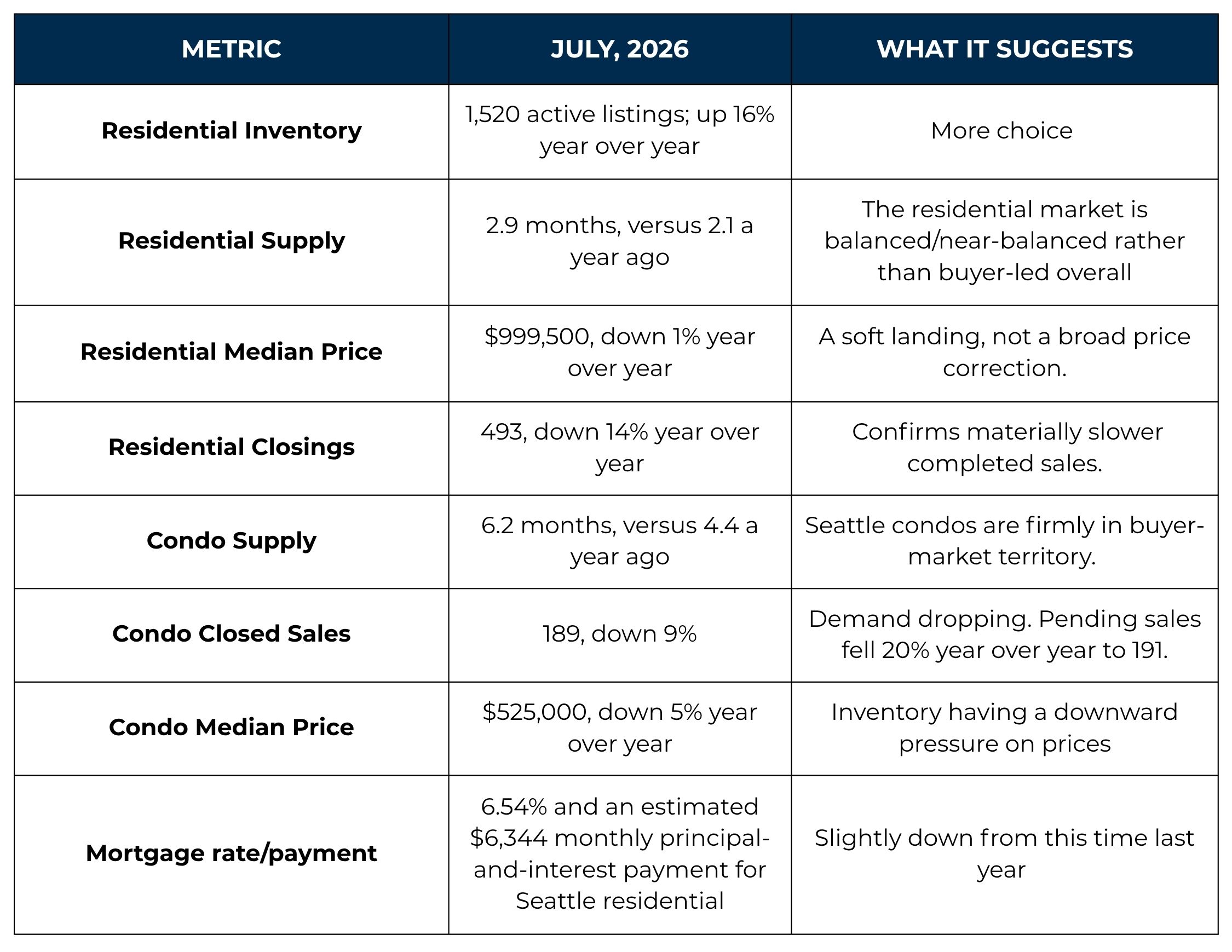
This is an important distinction for clients: price resistance is showing up more through longer decision cycles, selective demand, and increased negotiating room than through dramatic price declines.
Segment differences in Seattle
The headline market story changes meaningfully by product type. Single-family homes remain the strongest segment, townhomes are closer to balanced, and condos now offer buyers the most leverage.
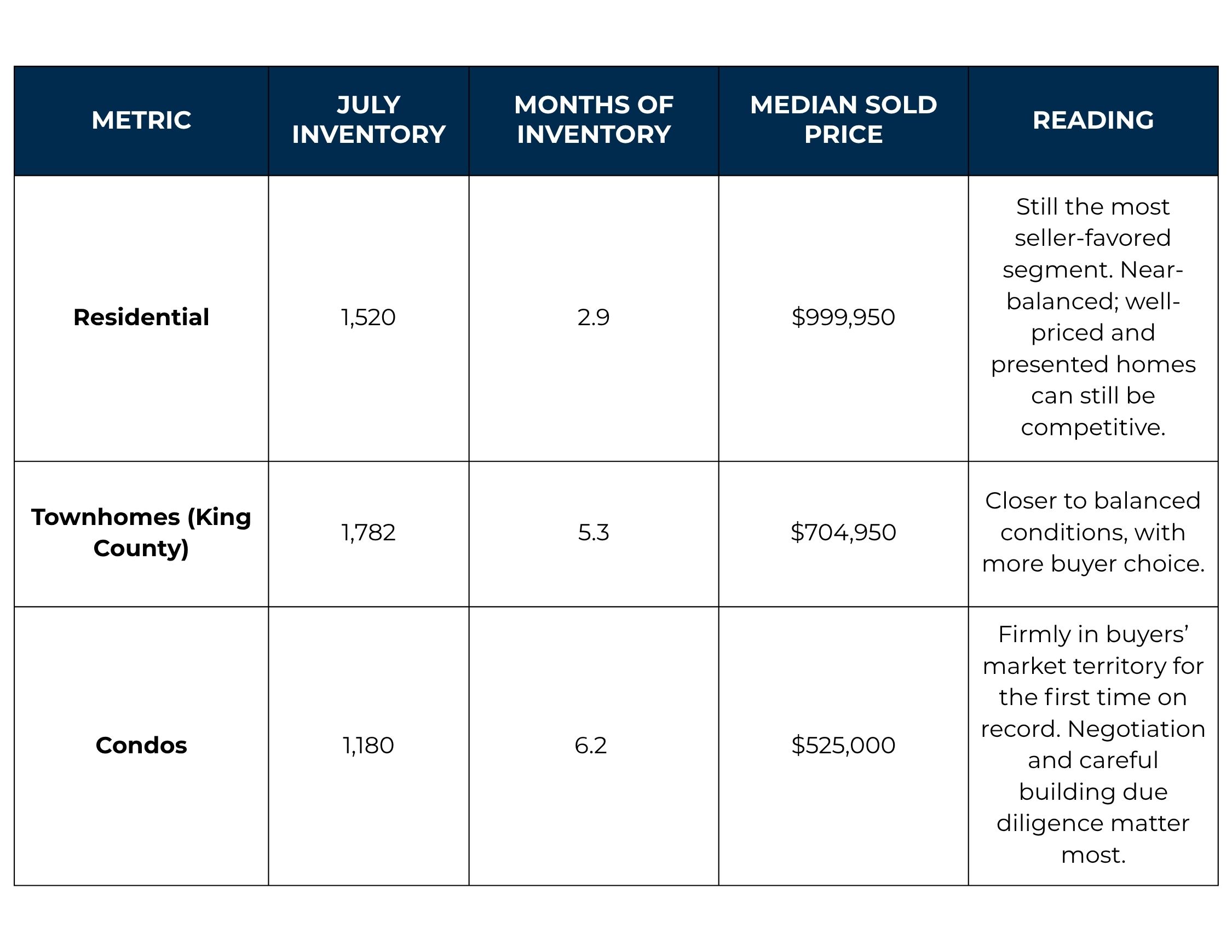
Condominiums offer buyers the clearest opportunity. Investor interest is beginning to return, suggesting that buying may now be less expensive than building, renting may cost as much as—or more than—owning, and the market may be nearing its bottom. Seattle condo supply reached 6.2 months in July, while active listings rose 12% and pending sales fell 20% from a year earlier. The median condo price declined 5% to $525,000 (Seattle vs. King County). Buyers should use the expanded selection to evaluate HOA financials, reserve funding, assessments, rental restrictions, insurance, and total ownership costs—not just negotiate price. Also, negotiations should consider back- end concessions like closing costs and interest rate buydowns.
A note about luxury homes[1]: First off, the market for luxury versus starter homes has split. The top 5% of houses by home value are selling fast, face shrinking supply shortages, and often draw bidding wars. Meanwhile, moderate home listings grew 4.5% YoY, yet are selling at a much slower pace.
[1] Defined as homes over $1,900,000
What it means for buyers and sellers
For buyers, this is one of the more favorable Seattle-area setups seen in several years. More listings, slower absorption, and higher inventory create more room to compare homes carefully, preserve contingencies, and negotiate terms that would have been difficult to secure in a tighter market.
Buyers should distinguish between a new, correctly priced listing and a stale listing. The July data supports this: well-priced new listings may still trade in 5–8 days and above asking, whereas homes that have sat more than 30 days generally offer more room for price or term negotiations.
Suggested buyer action items:
- Be fully underwritten and ready to compete for a strong new listing, especially in high-demand residential submarkets.
- Preserve inspection, financing, or appraisal protections where property history and leverage support them.
- Pursue price reductions, seller-paid closing costs, repair credits, rate buydowns, and timing flexibility on longer-market listings.
- For condos, perform deeper HOA and special-assessment due diligence before treating a lower price as a value.
For sellers, the penalty for missing the launch price has widened. July data shows that homes selling in the first 15 days achieved 100% of original list price at the median. By contrast, homes taking 61–90 days sold at a median 92% of original list price. In a market with more alternatives, the first two weeks are increasingly decisive. For condo sellers, the July data indicates only 9% sold above list, 41% sold below list, and 27% had a price change before sale.
Three practical seller priorities stand out in this environment:
- Prepare thoroughly before launch, including repairs, pre-listing inspection strategy, and cosmetic improvements where needed.
- Price for the market that exists now, not the market sellers remember from peak scarcity.
- Present the home with strong staging, photography, and marketing because buyers have more side-by-side alternatives.
- For condo sellers, the operational takeaway is clear: price discipline, building-level differentiation, and transparent HOA documentation are no longer optional.
Winning the offer is not the same as closing the sale. With fall-through risk elevated, sellers should assess buyer financing strength, appraisal exposure, contingency structure, earnest money, and timeline reliability—not solely the highest price. Maintain backup interest until contingencies are satisfied.
Looking Forward: Neighborhood and Property-type Strategy Wins the Day
Data provides direction, but neighborhood and property-type context matters more than ever. The best outcomes this quarter will come from matching strategy to product type, neighborhood, and timing rather than relying on a single headline about the broader Seattle market.
The most effective Q3 strategies will be highly specific: buyers should target segments where inventory has expanded fastest, and sellers should position homes against immediate neighborhood competition rather than broad metro headlines.
If you are considering a move, or simply want a grounded read on your neighborhood, reach out for a custom market snapshot, pricing strategy session, or buyer game plan tailored to your goals.
